
When NVIDIA CEO Jensen Huang announced on Twitter that the company would join forces with six Wall Street giants — including Apollo, BlackRock, and Blackstone — to mobilize more than $500 billion in third-party capital for AI compute, he delivered a forceful judgment: "In the AI era, compute is revenue."
But behind that declaration, a financial undercurrent far larger than the public numbers is beginning to emerge. Five U.S. hyperscalers — Amazon, Microsoft, Google, Meta, and Oracle — are using an elaborate "shadow lending" system to make trillions of dollars of debt effectively "disappear" from their balance sheets. Meanwhile, Wall Street's private credit institutions are turning away from the collapse of SaaS and taking over this enormous pile of capital, betting on an AGI future.
This is the most expensive arms race in technology history — and it may also be the most hidden accumulation of financial risk since the financial crisis.
I. The Disappearing Buybacks and the Borrowing Frenzy: The Hyperscalers' "Collective Impoverishment" Countdown
In the fourth quarter of 2021, the five technology giants collectively repurchased $48 billion of stock in a single quarter, setting a historical peak. By the first quarter of 2026, that figure had fallen to just $4.6 billion, a 90% decline over four years. Google completely stopped buybacks, Meta recorded zero buybacks for three consecutive quarters, and Amazon has made no further buybacks since mid-2022.
Where did the money go?
Data centers.
The projection from AI research firm Epoch AI is alarming: if current trends continue — operating cash flow growing at 23% annually while capital expenditure grows at 70% annually — the two lines will cross before 2027, meaning the giants will collectively become "impoverished" next year and return to an era of losses.
Morgan Stanley estimates that global data center capital expenditure will reach approximately $2.9 trillion by 2028. Only $1.4 trillion can be covered by the giants' own cash flow. The remaining $1.5 trillion must come from external capital.
And so the debt issuance frenzy began.
From 2020 to 2024, the five giants issued an average of approximately $28 billion in debt per year. In 2025, that figure surged to $121 billion. In just the first seven months of 2026, issuance had already approached $200 billion — six times the previous annual average.

Photo: Unsplash
Behind the borrowing are three problems they do not want to state openly: the collapse in public bond market subscription multiples, the cost of breaking the shareholder covenant of "zero debt + high buybacks," and — once debt ratings are downgraded, insurance companies and pension funds, the largest buyers, will automatically leave.
II. Wall Street's "Perfect Exit": The Great Capital Migration After the SaaS Collapse
At exactly the same time that technology giants are struggling for money, Wall Street's private credit giants are also experiencing a nightmare.
In the first half of 2026, one fund under Blue Owl, one of the world's largest private credit institutions, suffered two consecutive quarters of 40% redemption pressure, while its contractual cap allowed it to return only 5% of net asset value per quarter. Blue Owl's own listed shares fell from a high of $25 to below $8.
The reason was simple:
The SaaS software sector that the fund was heavily exposed to is being "killed" by the AI narrative — the market believes AI will cause software subscription businesses to lose their moats.
The data from the Bank for International Settlements is alarming: 60% of the loans that private credit provides to SaaS companies go to companies that simultaneously borrow from seven or more institutions. Ten years ago, that figure was less than 10%.
The excessive stacking of leverage means that once sentiment turns, the entire credit logic of the sector can collapse instantly.
But money always needs somewhere to go.
So these private equity giants, eager to reduce their SaaS exposure, almost seamlessly shifted their capital allocations toward AI data centers.
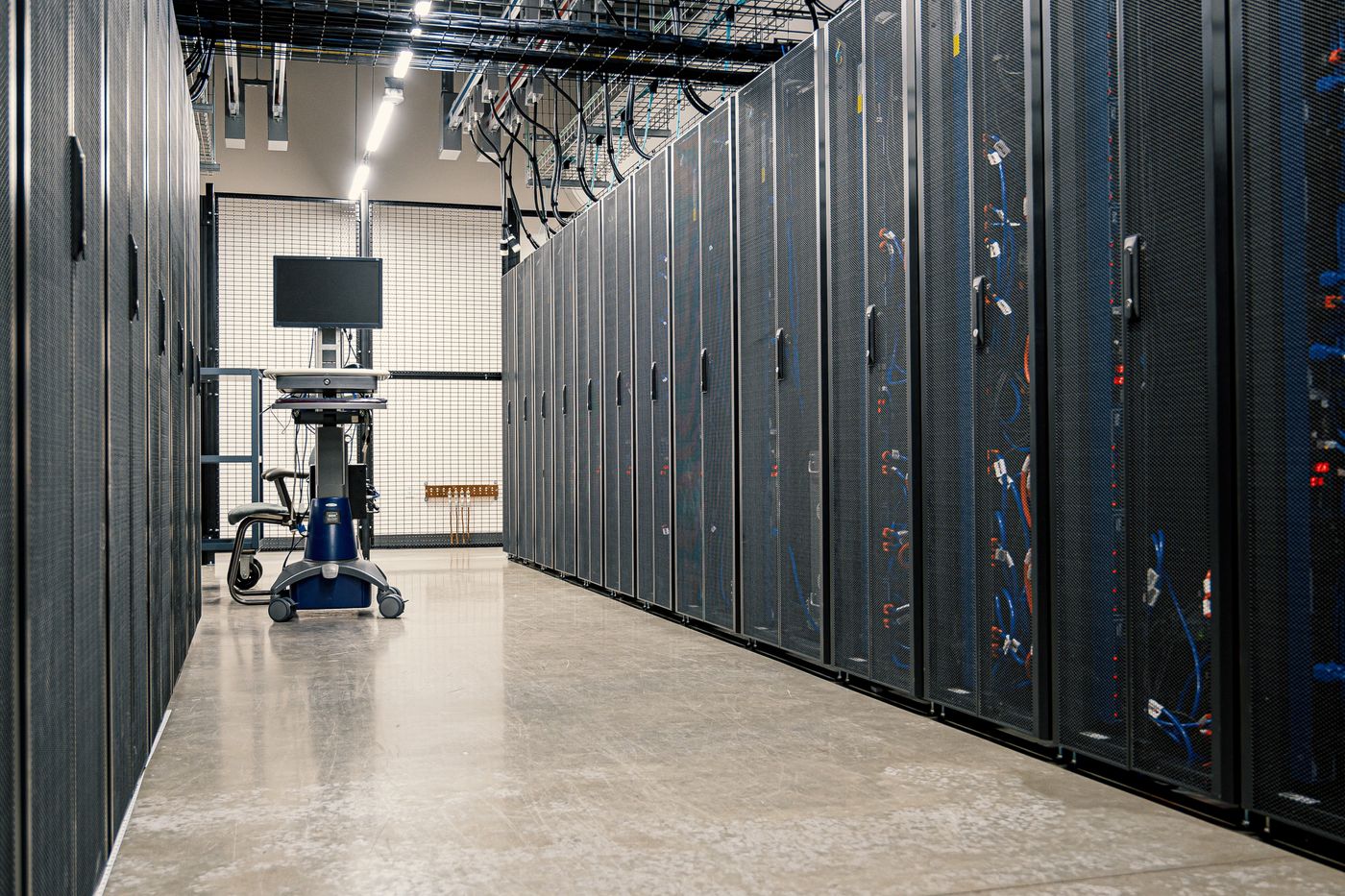
Photo: Brett Sayles / Pexels
In 2026, the "bidding war" around data center projects has been playing out on Wall Street almost every month — PIMCO taking an Oracle project that Blue Owl rejected at a higher price, while BlackRock, Blackstone, and KKR all entered the market.
The scale of packaging data centers into securities and selling them to investors has surged from roughly $27 billion in 2025 to a projected $30–40 billion a year across 2026 and 2027.
III. Meta's "Debt-Hiding Trick": How Did $27.3 Billion Disappear From the Books?
Let's break down a landmark transaction — Meta's Hyperion data center project in Louisiana, with total financing of $27.3 billion.
But on Meta's own balance sheet, the records directly related to the project amount to only $2.37 billion.
Where did the remaining $25 billion go?
The answer is a multi-layered SPV, or special purpose vehicle, structure:
The data center is registered under Laidley LLC, which operates it and has signed a 15-year power supply agreement
Above it is Beignet Investor, which issued the $27.3 billion of bonds
Above that, a fund under Blue Owl controls Beignet Investor, and therefore owns 80% of the data center property company
Meta holds only the remaining 20% and states in its financial statements that it does "not have the power to direct the activities that most significantly impact the Venture's economic performance," is therefore "not the primary beneficiary," and does not consolidate the entity.
And just like that, the debt disappeared from Meta's balance sheet.
But the money still has to be repaid.
Meta's leasing subsidiary Pelican Leap signed leases with the operator, and that rent flows through the SPV structure to the bondholders above.
At the same time, Meta also provided a residual value guarantee of up to approximately $28 billion — if Meta exits, Meta will make up the difference between the market value of the campus and the guaranteed amount.
In other words, the real collateral behind this $27.3 billion loan is Meta itself.
What is the cost?
If Meta issued debt of the same maturity directly in the public market, the cost would be approximately 5.5%.
The cost of borrowing through this SPV structure is 6.581% — which analysts estimate at roughly $270–300 million more in annual interest payments.
But this mechanism has already been rapidly replicated.
Less than a year later, Meta successfully issued another $12.5 billion of data center debt for the Sopaipilla project in Texas. This time, the 80% shareholder providing the capital changed from Blue Owl to BlackRock.
IV. The Five Giants' "Art of Repayment": The Real Bet
Meta builds shells, Microsoft uses financing leases, Google sells guarantees, and Amazon and Oracle rely on leases — the five companies use different methods, but fundamentally they are doing the same thing:
Turning "we build the building ourselves" into "we lease the building from someone else," thereby moving long-term debt outside the core field of vision of the balance sheet.
Let's break down the real debt into three levels:
Level | Content | Amount |
|---|---|---|
First level | Debt already borrowed — bonds, notes, loans | Approximately $445.8 billion |
Second level | Total on-balance-sheet obligations, including financing leases | Already on the books |
Third level | Signed leases that have not yet appeared on the balance sheet | Approximately $831 billion |
Procurement and construction commitments sit on top of all of it.
And Oracle has signed $260 billion of data center leases that have not yet started. Not a single dollar has yet been recorded as a liability.
V. NVIDIA Enters the Game: Compute Is Becoming an "Investable Asset Class"
On August 10, 2026, Jensen Huang personally announced that NVIDIA would join Apollo, BlackRock, Blackstone, Brookfield, Goldman Sachs, and KKR to establish an AI compute financing platform, with the goal of mobilizing more than $500 billion in third-party capital.
He provided two layers of confidence:
First, market pricing proves the case.
The A100 is still in commercial use six years after launch, suggesting an economic life approaching ten years. Meanwhile, the annualized rental price of an H100 rose from approximately $1.70 per GPU-hour in October 2025 to approximately $2.35 per GPU-hour in March 2026.
Second, NVIDIA is providing a backstop.
For certain projects, NVIDIA may provide "residual value support" for up to 25% of a given opportunity, assessed deal by deal.
But the words "residual value support" are precisely the most critical link in the entire risk chain.
Just as Meta provided a residual value guarantee for Hyperion, the company selling the GPUs is now stepping forward to guarantee their future value.
The problem is:
By the third year, the second-hand price of an H100 may be only 45% of the price of a new one.
Yet technology companies are extending depreciation periods from less than three years to six or even seven years, while data center facilities are being depreciated over 20 or even 30 years instead of little more than a decade.
Short seller Michael Burry has calculated that the costs being "under-counted" across 2026 to 2028 could reach $176 billion.
VI. Replaying the Subprime Crisis? The Industry's Answer and the Market's Silence
When Oracle's CDS, or credit default swap, price broke through 203 basis points, reaching its highest level since the 2008 financial crisis, the market inevitably began to think of a familiar script.

Photo: Unsplash
But the perspective of seasoned Wall Street professionals is more cautious.
First, the market is still small.
Data center debt remains a small fraction of the trillion-dollar corporate bond market and cannot be compared with the scale of U.S. housing relative to GDP in 2008.
Second, bank regulation is tighter.
After the collapse of Silicon Valley Bank, the Basel III endgame was loosened to some extent, but bank leverage ratios and regulatory requirements remain far higher than before 2008. It would be difficult for localized risk to spread into a systemic crisis.
Third, real demand is providing validation.
Microsoft Azure's latest quarterly revenue growth reached 43%, while contracted but unrecognized revenue reached $678 billion, up 84% year over year.
As long as end-market demand for compute leasing continues, the capital cycle can keep turning.
But there are also concerns that cannot be ignored.
Private credit's funding chain ultimately ends with pension funds — meaning ordinary taxpayers' retirement accounts are ultimately on the hook.
The same asset managers are taking turns acting as equity holders, creditors, issuers, and sole buyers across different transactions. Interconnectedness risk has already attracted the attention of the U.S. Office of Financial Research and the Financial Stability Board.
In the second quarter of 2026, investors requested $15.6 billion in redemptions but actually received only $5.9 billion — the illusion of liquidity is beginning to be broken by reality.
VII. Conclusion: The Bet Has Already Been Placed. The Risk Will Not Disappear.
Meta builds shells, Microsoft uses leases, Google sells guarantees, and NVIDIA itself provides the backstop.
Every layer of the structure has a price.
Every time something is taken "off balance sheet," someone else takes over another portion of the risk.
The balance sheet can become cleaner, but risk does not disappear into thin air. It is simply sliced, packaged, guaranteed, and distributed among different people along the financial chain.
For the past two decades, the market has been accustomed to thinking of Silicon Valley technology companies as an asset-light model — write code, sell software, generate cash flow, and buy back shares.
AI is completely reversing that logic.
Secure chips, secure power, acquire land, build data centers, and then use the cash flows of the next ten or twenty years to pay for today's construction.
Silicon Valley and Wall Street are both betting on the same assumption:
AI token demand will continue to grow exponentially, indefinitely.
Before AGI actually arrives, whether this assumption is faith or a bubble remains unanswered.
But one thing is certain:
Once compute is monetized, securitized, and amplified through layers of leverage, it is no longer merely a technology story. It becomes a financial story.
And throughout financial history, every asset class inflated by leverage eventually faces the same ending —
the market reprices it.
Carol Chen
Founder, Compute Notes
Builder of AI-native businesses and investor in AI infrastructure
LinkedIn: linkedin.com/in/carol-c-76461498
Website: computenotes.co
Network: network.computenotes.co
Get a free AI spend teardown → watt.computenotes.co